
WITHOUT CONSULTATION, WITHOUT NOTICE, AND WITHOUT JUSTIFICATION THAT HOLDS
Coalition of credentialed advocates calls for federal intervention before April 30 deadline
EDMONTON/VANCOUVER – The University of Alberta is proceeding with the permanent removal of the University War Memorial Pipe Organ from Convocation Hall – a listed memorial in Veterans Affairs Canada’s National Inventory of Canadian Military Memorials – without consulting Veterans Affairs Canada, without consulting the Royal Canadian Legion, against the written recommendation of the organ’s own builders, and in apparent contravention of the University’s own governance policies. Convocation Hall locks April 30, 2026. There are fourteen days left.
When confronted by a coalition of credentialed scholars, musicians, and heritage advocates, University President Bill Flanagan responded with a single argument: that the 1978 Casavant organ is not, in fact, the memorial organ. The University of Alberta’s own archival record, including a 1978 recording of his predecessor speaking at the instrument’s rededication ceremony, says otherwise.
The Memorial
The University War Memorial Pipe Organ was first erected in 1925 and dedicated on Armistice Day to the 82 University of Alberta students, staff, and alumni who gave their lives in the First World War. On November 11, 1945, it was formally rededicated to include the 148 University of Alberta men who fell in the Second World War. The organ stands as the memorial to those 230 fallen, their names permanently commemorated alongside it.
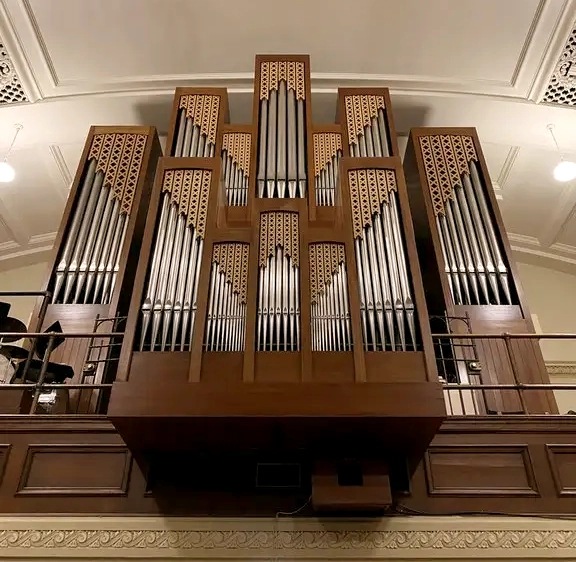
The current instrument – a 1978 Casavant Frères tracker organ, the only instrument of its kind in Western Canada – was installed following a years-long institutional commitment to replace the original with an instrument of equal or greater standing. Its replacement value has been confirmed in writing by Simon Couture, Vice President of Casavant Frères, at approximately $3 million.
The organ is listed in Veterans Affairs Canada’s National Inventory of Canadian Military Memorials. That listing exists precisely to ensure that decisions affecting such memorials trigger federal consultation.
What the University Did Not Do
There is no public record that Veterans Affairs Canada was consulted at any stage of this process. There is no record that the Royal Canadian Legion was notified. There is no record that the University’s own General Faculties Council reviewed the decision, nor
that the Board of Governors approved it – both of which are required under the University’s Space Management Policy for any construction or demolition of considerable size, cost, or impact. The Head of the Department of Music has confirmed in writing that he was kept entirely out of the planning process.
The University did contact Casavant Frères, but only to ask about sealing the organ during renovation, not about removal. The builder’s Vice President advised explicitly against removal and put that recommendation in writing. That counsel was received and, apparently, disregarded.
The University announced the removal on April 2, 2026. Convocation Hall locks April 30. Twenty-eight days. No public consultation. No heritage assessment. No federal engagement. This is the second attempt: in 2019, a petition gathered more than 20,000 signatures and the removal did not proceed. This time, the University appears to have been counting on no one noticing in time.
That this is unfolding in the year the Royal Canadian Legion marks its centenary makes the silence all the more difficult to accept.
The President’s Argument – and the Record That Refutes It
In responding to the coalition, President Flanagan argued that the 1978 Casavant instrument does not carry the memorial standing of the original 1925 organ, which he states was “removed many decades ago.” On this basis, the University appears to consider itself free to treat the 1978 instrument as a removable performance fixture.
A recovered University of Alberta archival recording from October 1, 1978 – the date of the Casavant organ’s inaugural concert – directly contradicts this position. In it, University President Harry Gunning states on the record: “This new tracker organ, which was manufactured by Casavant Frères in Saint Hyacinth, Quebec, is, in fact, a memorial and reaffirms the dedication associated with the old organ.” President Gunning then read the original memorial dedication plaque aloud and confirmed: “This plaque will be attached to the new organ, to re-emphasize the fact that this is still a memorial organ.”
The recording was located by University of Alberta Digital Curation Librarian Sean Luyk and has been reviewed and confirmed by Dr. Marnie Giesbrecht, D.Mus., Professor Emerita and University Organist.
President Flanagan’s argument rests on a distinction his own institution’s documented record does not support. The suggestion that a memorial loses its standing when its physical form is renewed in kind is, to put it plainly, without precedent in the treatment of any other class of war memorial. A veteran who returns from service is not less a veteran because they carry a prosthesis where once they had a limb. The sacrifice does not reside in the original material. It resides in the intention, the dedication, and the unbroken chain of commemoration – all of which, in this case, are documented.
The Builder’s Position
Simon Couture, Vice President of Casavant Frères, has provided the following authorized statement: “Casavant Frères’ first recommendation was to leave the organ in place, and to seal it before work is done in the room, so there would be minimal work on the organ needed after the renovation of the hall is completed.”
Voices
Dr. Marnie Giesbrecht, D.Mus., Professor Emerita and University Organist, University of Alberta, Fellow of the Royal Society of Canada, and author of Lest We Forget: A History of the Memorial Organ in Convocation Hall at the University of Alberta:
“Why end one hundred years of organ music sounding in the Old Arts Building and remove a unique and iconic Casavant pipe organ — one of its kind in Canada and a national war memorial? The undergraduate and graduate organ programs at the University of Alberta were quietly dismantled, and now the organ will be secretly removed.”
Chellan Hoffman, National President, Royal Canadian College of Organists:
“Tear down a pipe organ and you tear down a community. Rather than appreciating it as a piece of art, technology, history, and community that should remain in its home, it somehow becomes a tear-down — considered worthless by those who have no idea of its value.”
Dr. Haley Simons, D.Mus., University of Alberta alumna:
“We are not just fighting for an instrument. We are fighting for what it represents. It’s impossible to remain silent when a venerated memorial is so cavalierly dismembered from its original intention. We have a duty to give voice to those who no longer have one.”
Dr. Linda Arsenault, D.Mus. (Governor General’s Gold Medal; Distinguished Dissertation Award), University of Alberta alumna:
“If we disgrace our glorious dead by relegating them to a mere statistical heap and by removing and desecrating their memorials, then we, as a people, have lost our collective soul.”
Dr. Joachim Segger, D.Mus., Professor Emeritus, Kings University, President, Royal Canadian College of Organists, Edmonton Chapter; Honorary Fellow of the Royal Canadian College of Organists; Fellow of the Royal Society of Canada:
“The Casavant memorial pipe organ in Convocation Hall is a stunning piece of visual art with over two thousand speaking pipes that fills the hall with glorious sound. It serves as a musical and visual reminder of those lost during the world wars every time music of lament and joy sound forth from its magnificent pipes. Convocation hall will be diminished by favoring the need for accessibility over the one memorializing our fallen soldiers. Let’s be proactive and do both.”
The Ask
The coalition is requesting that Veterans Affairs Canada formally engage the University of Alberta regarding its obligations with respect to a listed Canadian military memorial, and that the University pause all renovation activity affecting the organ pending that consultation. A formal briefing note was submitted to the Honourable Jill McKnight, Minister of Veterans Affairs, on April 14, 2026. Additional outreach to all levels of government is underway.
Provincial ministers responsible for Culture and Post-Secondary Education will be contacted in parallel.
About the Coalition
The submission to Minister McKnight was made by Dr. Haley Simons, D.Mus., Vancouver, alumna of the University of Alberta, and co-signed by Dr. Marnie Giesbrecht, D.Mus., Professor Emerita and University Organist, University of Alberta, Fellow of the Royal Society of Canada, former National President of the Royal Canadian College of Organists, and author of Lest We Forget; and Dr. Joachim Segger, D.Mus., President, Royal Canadian College of Organists, Edmonton Chapter.
Media Contact:
Haley Simons, D.Mus.
haleysimons@yahoo.com
780-991-2007
–